
AI Agents in DeFi: The Rise of Autonomous Yield Farming
Explore how AI agents in DeFi are automating yield farming, boosting returns, and reshaping crypto investing in 2026.
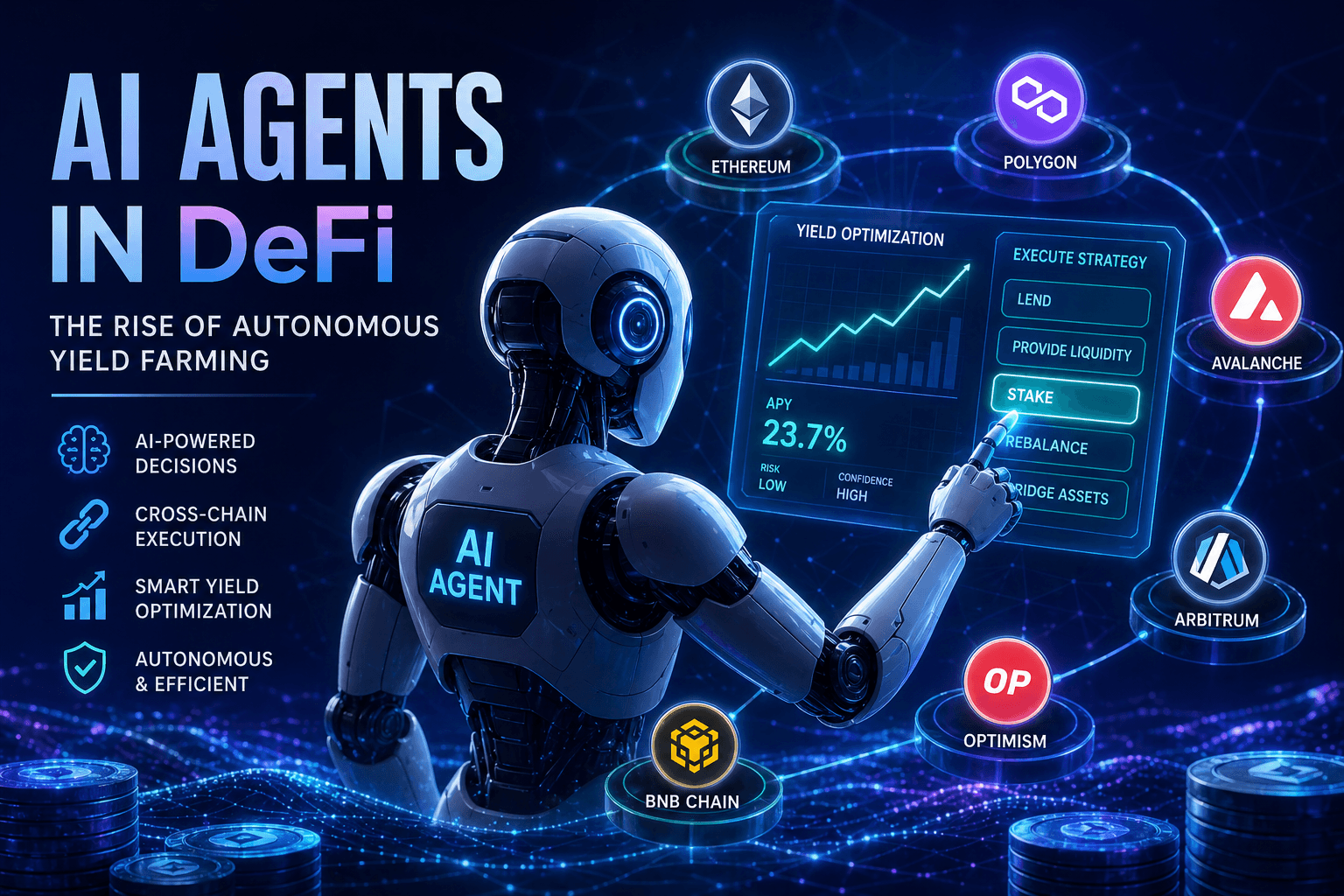
AI agents in DeFi are becoming more popular because machine learning systems are now being used by developers and the protocol community to implement yield farming techniques. Information provided by analytics platforms and developer communities indicates that there is an increasing trend of automated capital allocation in decentralized finance applications. Although manual strategies are still being employed, it appears from the available data that algorithmic agents are doing increasingly difficult work such as liquidity reallocation and multi-protocol optimizations.
AI Agents in DeFi Drive Automated Yield Strategies
AI agents in DeFi employ smart contracts along with machine learning algorithms. Such agents analyze available data, identify opportunities for yields and perform transactions automatically. Compared to ordinary bots, these systems use predictive models to adjust to changing market conditions.

The developers say that AI agents now simultaneously work in several different protocols at a time. They are able to analyze the rate of lending, liquidity pool rewards and rewards for tokens. Therefore, they can switch their resources from one platform (e.g., decentralized exchanges and lending protocols) to another instantly. It increases efficiency greatly.
There is also information that the usage of AI is becoming more and more common in automated vaults and strategy managers. Some platforms use such AI-based vaults, which rebalance assets according to their volatility and reward system. These vaults use both pre-programmed rules and adaptive models.
Machine Learning Models Power DeFi Automation Systems
DeFi applications utilize AI agents through various machine learning models. These include reinforcement learning, time series predictions, and anomaly detections. Each model provides unique benefits to optimizing yield opportunities in the process.

For instance, reinforcement learning enables the testing of strategies and making optimal choices. The algorithm assesses the results and makes appropriate adjustments for achieving higher rewards. Time series predictions forecast price movements and fluctuating interest rates. Therefore, the agent can take advantage of allocations before such market occurrences.
In addition, the anomaly detector identifies outliers including changes in liquidity or exploitation activities. This model aids in risk management by implementing safety measures against these issues. Developers claim that the integration of models provides more efficient results and robustness to AI applications.
Furthermore, infrastructure becomes relevant to the operation of the application. Off-chain computing is employed to execute machine learning algorithms. However, these algorithms interact with smart contracts deployed on the chain. Such infrastructure allows maintaining performance while not overburdening the network.
On-Chain Activity Shows Growth in Autonomous Participation
Blockchain data indicates that AI agents in DeFi are increasing their share of transaction volume. Based on wallet clustering analysis, there is evidence that some high-frequency trades are executed via automated processes as opposed to individuals themselves.

A number of developers and analysts have provided insights via social media platforms. In several tweets, these people have highlighted the increase in activity within automated vaults and arbitrage bots. They observed that these bots are capable of trading much faster than any manual approach. Additionally, the integration of AI in the management of liquidity positions was mentioned in some of these tweets.
The interoperability of various blockchains has only further fueled this phenomenon. AI-driven agents are now utilizing bridges and cross-chain protocols to shift assets across multiple blockchains. This means that yield strategies are no longer constrained within a particular blockchain ecosystem.
Security and Efficiency Remain Key Focus Areas in DeFi AI
AI agents in DeFi introduce new considerations for protocol security and system design. While this makes things more efficient, however, increased dependencies on smart contract reliability and data accuracy pose a problem. Developers are trying to solve this issue via auditing and monitoring methods.
Another aspect that is being taken care of by developers is security issues in relation to smart contracts. Interactions with many protocols make AI agents vulnerable to cumulative risks. To prevent any significant losses, developers use such safety mechanisms as circuit breakers or multi-signature control options.
Gas optimization and speed of execution are other parameters affecting the efficiency of operations with AI agents. Since transactions cost money, AI agents should be able to calculate their worth versus potential gains. In some cases, batching and Layer-2 solutions are used to cut down transaction costs.
Final Thoughts
Further developments in the area are likely to bring new features into AI agents within DeFi protocols. For example, developers are actively researching ways to increase the accuracy of predictive models and introduce real-time data.