
Backend Performance Bottlenecks at Scale Explained
Learn how to identify and fix backend performance bottlenecks at scale using proven techniques for APIs, databases, and system optimization.
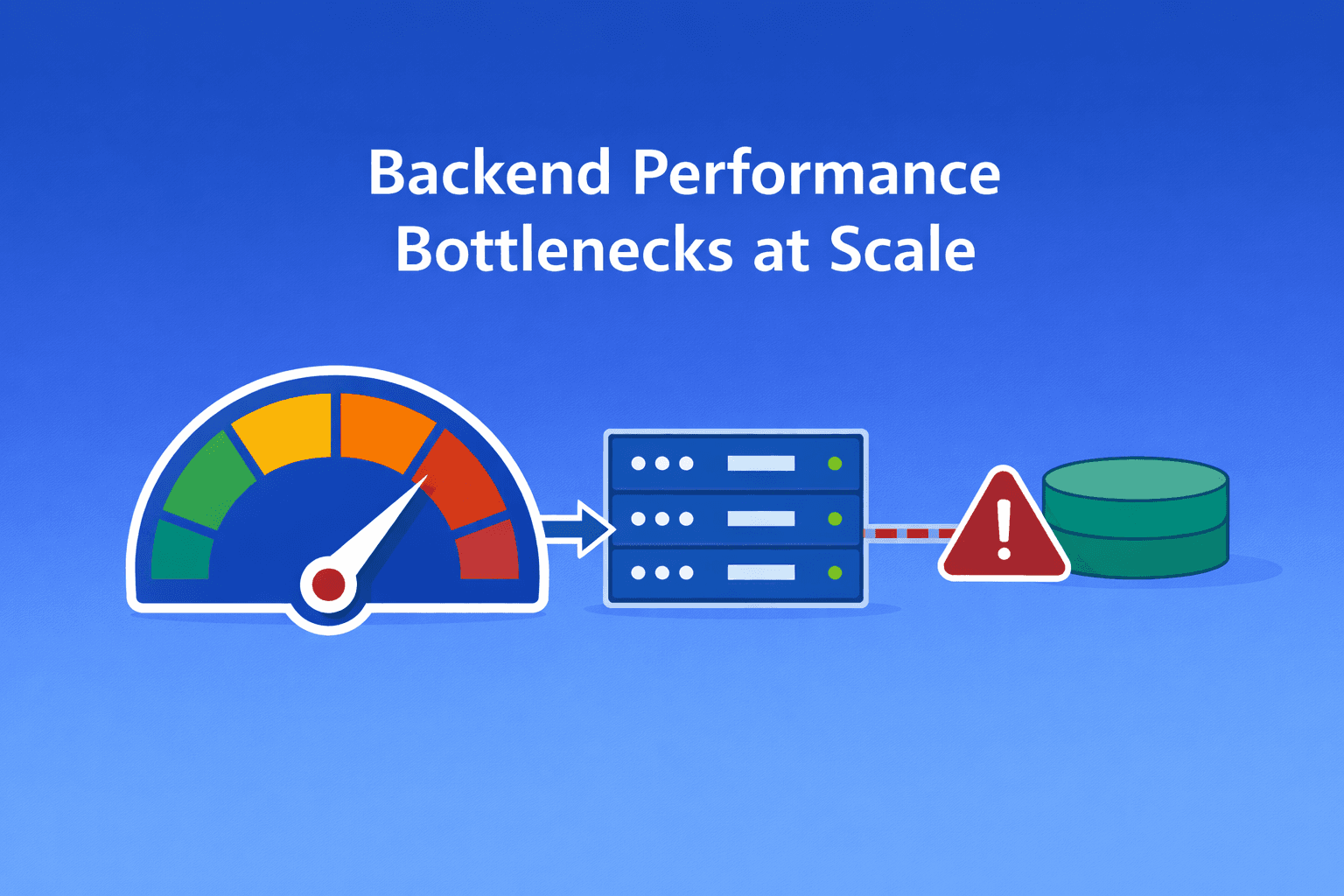
As backend performance bottlenecks become a problem as production systems grow due to increased workload, the evidence shows increasing delays in API and database performance as the traffic rises. With the help of distributed tracing systems like Datadog and New Relic, it is becoming increasingly evident that performance bottlenecks happen throughout various stages instead of at a single fault point.
Backend Performance Bottlenecks Surface in Production Systems
The engineering community observes that the challenges in backend performance appear only once systems leave their testing grounds and are subjected to actual traffic. Such signs as response time variance, throughput drops, and increased error rates are experienced even without any change in the business logic implemented.
From the monitoring information, one notices that latency builds up during the processing of a request. A typical request involves several operations including API gateways, the business layer, and database queries, among others. Inefficient performance in any of these operations can add up to form significant response times.

From system log records and traces, one finds that backend performance challenges do not stem from one place but rather a combination of several delays in other processes. Such challenges are common in microservices architecture, where service communication adds latency to the process.
Tracing and Profiling Reveal Hidden Latency Sources
The observability tools play an important part in finding performance problems on the backend side. The tracing tools help detect where a specific request is handled across multiple services. It shows latencies throughout the entire process. Engineers find which endpoints and service calls are responsible for the problems.
The profiling tools provide more information about resource usage. Latency may occur due to CPU-bound operations, memory leaks, or blocking I/O operations. The engineers analyze profiling data to find inefficient function calls. They find functions with high execution time.
Logging and metrics correlation result in better problem detection. When the database or API latencies rise along with the overall latency, the root cause becomes apparent.
Database and Network Constraints Drive Bottlenecks
However, database performance remains the biggest issue for backend performance issues. Queries that lack indexing take longer to complete, especially when there is a lot of information present. Table scans and inefficient join operations impose additional strain on databases, causing delays in requests’ handling.
The connection pools also become an issue due to their limit. Applications that exceed the number of available database connections face request queuing, resulting in increased latency. This problem is common in highly concurrent environments with poor connection management.
Network latency can add another point of delay. Microservices architectures involve several API calls inside the system. Every network call comes with latency, even within a single data center. Latency is further prolonged when external APIs are involved.
Optimization Techniques Improve Backend Performance Stability
Caching prevents duplicate database calls and increases speed. The use of caching mechanisms like Redis that utilize in-memory databases helps access commonly used data more quickly. Query optimization is implemented at the level of the data itself. Techniques include indexing often-queried columns and minimizing data returned. Developers also optimize queries to eliminate unnecessary joins.

Load balancing involves distributing requests among several servers rather than overloading one particular server. Horizontal scalability complements load balancing and keeps performance steady despite fluctuations in the volume of traffic. Asynchronous processing enhances efficiency by handling non-blocking operations outside the main request flow.
Scaling Strategies Aim to Prevent Recurring Bottlenecks
Traffic control helps limit excessive requests and prevent server overload when there is heavy traffic. This technique helps keep the servers running efficiently without any overloads.
Monitoring helps detect problems within the backend and resolve them in good time. This is because engineers observe the system’s performance over time to detect possible issues that need fixing.
Incorporating scalability within system architecture has also become popular in modern system design. Engineers are increasingly adopting scalable system architectures with optimized communication between services.
Final Thoughts
The backend bottleneck arises due to increasing scales and workloads of the system. The monitoring data indicates that delays occur at multiple levels and not a particular one. Tracing and optimizing are some of the solutions employed by engineers when tackling this problem.