
AI-Powered DeFi Risk Engine for Rug Pull Detection
Learn how to build an AI-powered DeFi risk engine to detect rug pulls early using on-chain data, ML models, and smart contract signals.
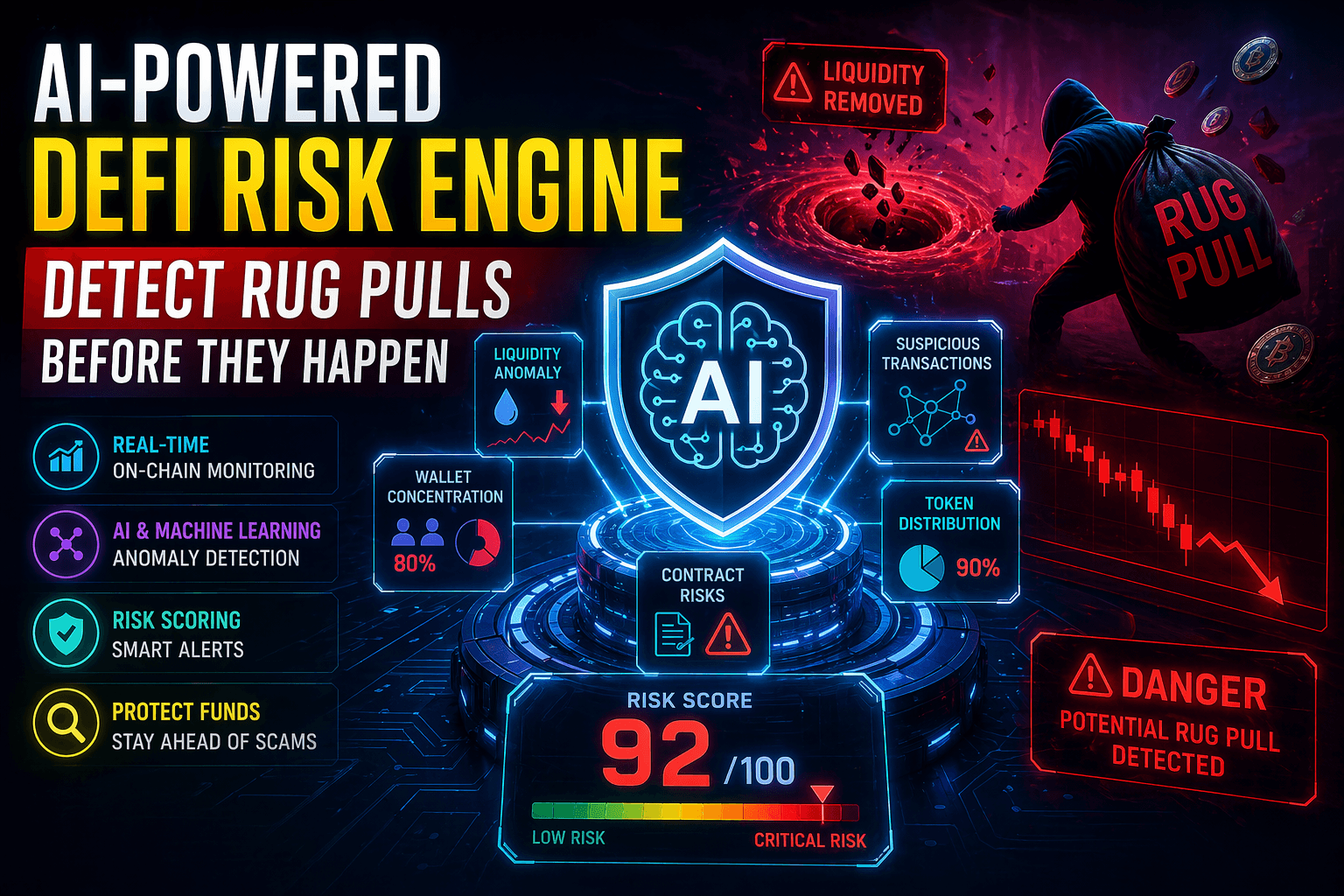
AI-Powered DeFi Risk Engine: A novel methodology for decentralized finance security has been proposed, and developers have started looking at AI-driven mechanisms for recognizing any fraud that might be happening in the system. Early discussions that have taken place in developer forums suggest that machine learning models have become increasingly popular for identifying the initial stages of rug pulls. This method involves monitoring the behavior of funds on the blockchain network, including how tokens are being distributed and whether there are enough liquidity tokens.
Rising Focus on AI in DeFi Security Systems
AI-based solutions for DeFi monitoring are increasingly being adopted by developers, as the patterns of attacks change. Manual inspection and static code analysis are prone to missing many attacks because these techniques cannot analyze the data dynamically. An AI-based system processes large amounts of blockchain information and quickly identifies suspicious activities.

The inputs may comprise transaction history, liquidity pool changes, and smart contract interactions. The AI-based DeFi risk engine then generates risk scores based on its analysis of the inputs. This approach gives platforms the opportunity to recognize risky behavior patterns without necessarily using pre-existing rules.
Discussions on social media sites such as X demonstrate increased awareness regarding automatic risk identification. Several individuals highlighted how the use of anomaly detection algorithms could reveal unexpected liquidity extraction events or abnormal wallet clusters.
Architecture Behind AI-Powered Risk Engines
An AI-powered DeFi risk engine can generally be divided into a few layers for scalable and quick operations. In the data ingestion layer, connections are established with blockchain nodes and other services for receiving stream data about transactions.

Raw data is then preprocessed in the feature engineering layer, where metrics such as wallet concentration, token holder movements, and permissions assigned in smart contracts are calculated to serve as input variables for machine learning models.
In most cases, gradient boosting or graph learning techniques are used in the models to evaluate the data as suspicious or safe. Relationships between wallets are discovered through graph learning. The model’s output feeds directly into the scoring engine.
Key Indicators Used in Rug Pull Detection
AI-based systems make use of some distinct features to determine if a rug pull could occur. Liquidity activity is still a common parameter used for the detection of any such activity. In many cases, sudden decreases in liquidity of pools precede exit scams, and AI-based models detect such trends in short periods of time.

Token distribution is another factor that is considered when determining the probability of exit scams. If tokens are concentrated in a small number of wallets, then there might be centralization and possible malicious activity, especially if transfers of tokens take place very rapidly.
Smart contract permissions are another important feature in such cases. Contracts with permissionless minting and overriding of any restrictions raise doubts.
Challenges in Real-Time DeFi Risk Analysis
Nonetheless, there are a number of technical issues that developers have to overcome while implementing an AI-based DeFi risk engine. Firstly, blockchain data tends to be noisy, making its pre-processing quite difficult. Furthermore, accurate labeling of previous scam attempts requires high-quality datasets, which do not exist for the moment.
Attack tactics are constantly changing, which means that models will need frequent updates. This could prove problematic because static training might miss emerging scam tactics. Thus, constant updating is necessary.
Moreover, there are scalability problems related to the ability to process millions of transactions across various blockchains. Developers will need to optimize the system and achieve both accuracy and fast performance.
In time, AI systems might become a standard part of DeFi security infrastructure. However, developers continue to experiment and exchange knowledge to improve their creations.