
GenAI Systems in Production: From Prototype to Scale
Learn how to build GenAI systems in production with scalable architecture, cost control, and reliable LLM deployment strategies.
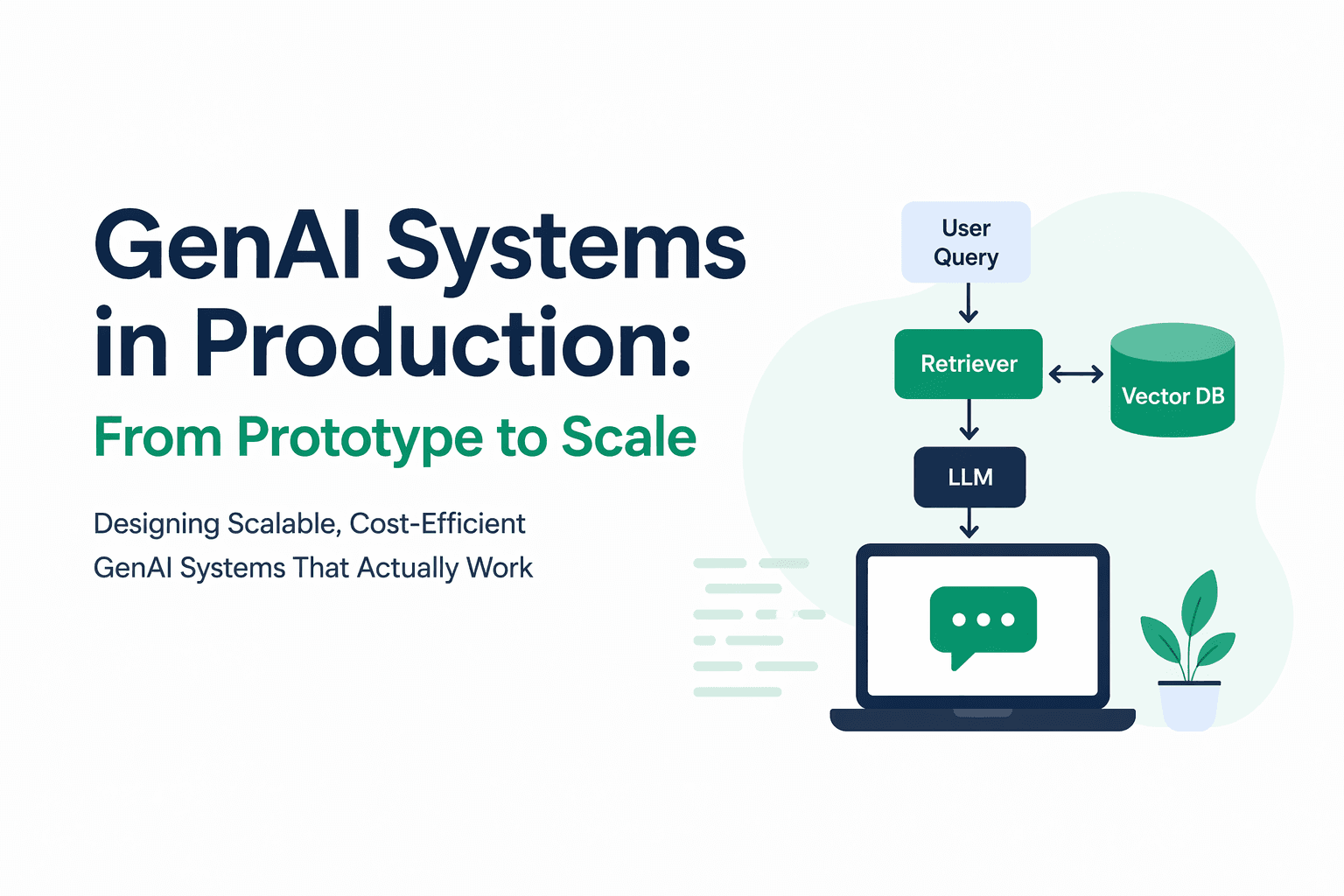
GenAI systems in production continue to attract attention as engineering teams move beyond experimental deployments into real-world environments. Observations made from various platforms used by developers, as well as engineering discussions, reveal that many large language model use cases experience problems with stability and economics post-deployment. Even though these systems may demonstrate the required behavior, their practical application exposes flaws related to scaling, latency, and architecture issues.
Examples reported through tools such as Datadog and New Relic indicate that issues occur more frequently when multiple processes are running concurrently rather than separately from each other. However, developer blogs and social media forums point out that the growing issue is that of increasing cost and latency.
Production Failures Surface Under Real Traffic Conditions
From the engineering standpoint, it becomes clear that GenAI systems in production work differently when subjected to actual user traffic. Prototype systems work in controlled environments where they receive relatively few requests. Workload demand for production systems is erratic, leading to the formation of queues.
From the analysis above, one can conclude that the time it takes to process a request is made up of several parts. These include API gateway, inferencing layer, and the database call. When one component slows down, it affects the entire system. This layered delay becomes more visible during peak traffic periods.
Another pattern appears in systems that rely heavily on external LLM APIs. Rate limits and service interruptions create points of failure. In the absence of any fallback methods, these disruptions lead to downtime. The engineering conversations focus on the requirement of redundancy and retries to ensure that the systems are available.
Architecture Patterns Evolve for Scalability
The use of modular architecture helps overcome the above problems when building GenAI systems using the production mode approach. This architecture separates different components, such as request processing, inferences, and data fetching. Each individual component is independently scalable.

Retrieval-Augmented Generation (RAG) framework has gained prominence in this regard. It integrates vector databases to retrieve context before generating responses. This reduces hallucination and improves output relevance. It also lowers token usage by limiting unnecessary prompt expansion.
Queue-based systems also play a role in handling traffic efficiently. Instead of processing all requests synchronously, tasks move through distributed workers. It ensures that there is no overload and keeps stable response times. According to reports by engineering teams, throughput levels improve when asynchronous requests replace API calls.

Cache mechanisms also aid in scaling the systems further. Outputs used frequently are stored and can be reused. There is, therefore, reduced computing cost and less use of external APIs. Latency and cost are hence lowered in GenAI services.
Cost Pressures Drive Optimization Strategies
Cost management remains a central issue for GenAI systems in production. Token-based pricing models create variable expenses that increase with usage. Without optimization, operational costs rise quickly under high demand.
Prompt design plays a key role in cost control. Engineers tune the prompts by eliminating superfluous tokens without sacrificing context. Fewer tokens are then processed during each call. Shorter prompts save money on API costs and increase speed.

Another important factor when considering costs is the model. Not all tasks require high-capability models. Teams deploy smaller models or fine-tuned alternatives for specific use cases. This approach maintains performance while reducing cost per request.
Batch processing provides another method for optimization. Multiple inputs are processed together where possible. This increases efficiency while lowering costs. The monitoring system will analyze user habits and will enable them to discover further opportunities for cost savings.
Reliability and Observability Shape Production Readiness
Reliability in GenAI models can be ensured by using observability best practices during the production phase. Data obtained from logging, metrics, and tracing will help detect issues with the system, such as system failures and bottlenecks.
The need for fallback measures cannot be overemphasized when trying to prevent system downtimes. In the event of a system failure, the request will be handled by the backup models and caches.
Production systems are also vulnerable to security threats. Input validation and filtering are some of the methods used to address the issue. There are various approaches to protecting API keys and other valuable information in GenAI production systems.
Load testing is an important step before production deployment. It helps teams assess how their systems respond to high loads.
Final Thoughts
Producing genAI models involves ongoing development based on the architecture design, cost reduction, and reliability enhancement. The move from the prototype stage to the production one leads to additional limitations that need systematic approaches to be resolved. Engineering approaches concerned with scalability and efficiency determine the behavior of genAI systems.