
Why Most LLM Apps Fail in Production and How to Scale
Learn why LLM apps in production fail and how to build scalable GenAI systems with proper architecture, evaluation, and deployment strategies.
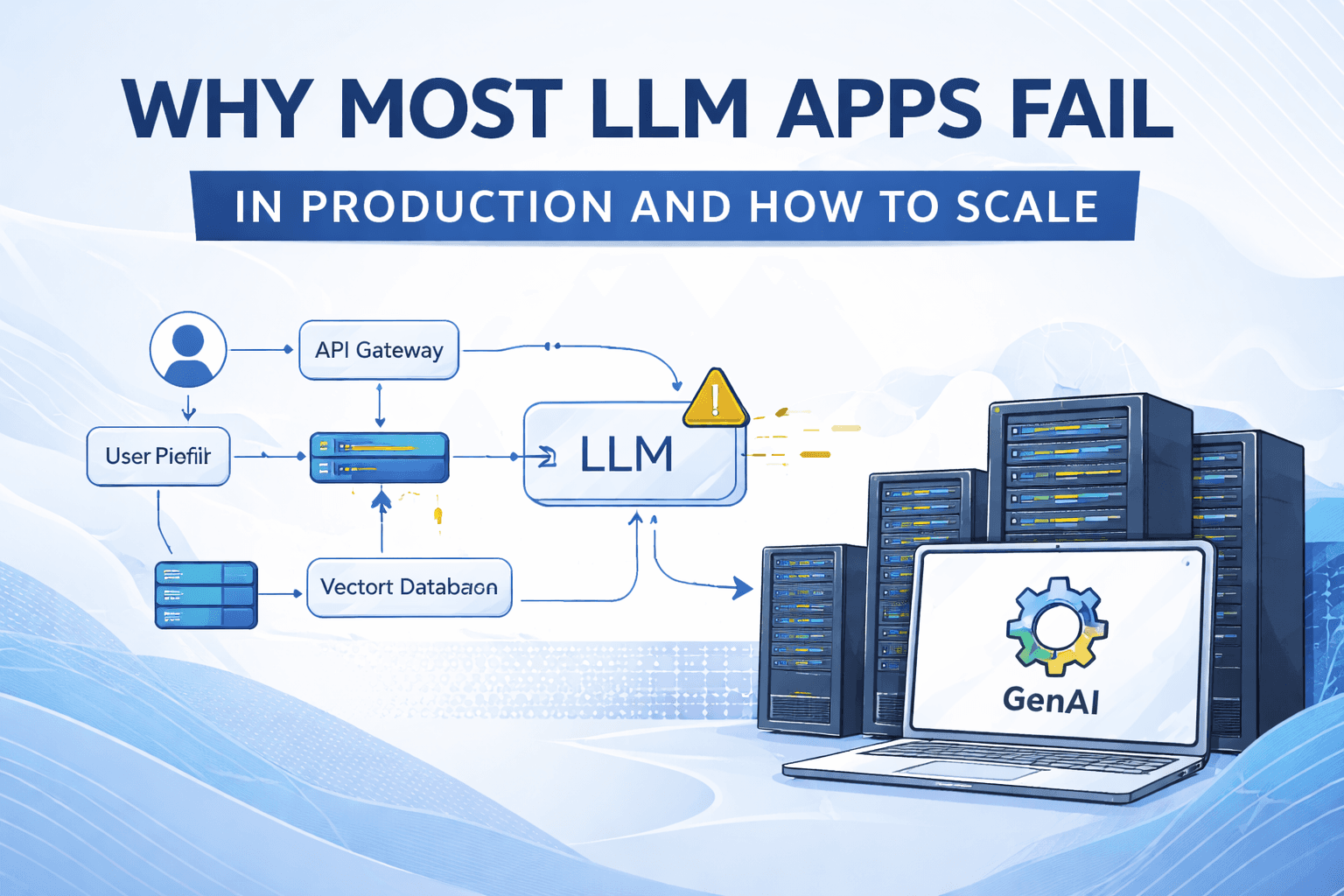
Common Failure Points of LLM Apps in Production Systems
LLM applications tend to work well during the prototyping stage but fall apart once they are used in real-world scenarios. Early demonstrations often depend on controlled data, few users, and low latency requirements. Once such applications are put under pressure with unpredictable data and scale, they start becoming unstable.

One of the reasons for such behavior is that most LLM developers do not have an evaluation process in place. Many teams prefer using subjective evaluation rather than objective performance indicators, which makes it difficult to spot any flaws in an application.

Another frequent problem is bad prompt engineering. Prompts that work in isolation fail when handling diverse user inputs. This leads to unpredictable outputs and increased token usage, which directly affects cost and performance.
Why Scaling LLM Apps in Production Is More Than APIs
Scalability of LLM applications in production goes beyond just hooking up to an API. The infrastructure is crucial for addressing challenges like concurrency, latency, and reliability. The design should cater to scaling request loads without compromising on quality.
Token cost management is another challenge. As usage increases, the cost of inference grows rapidly. Without optimization strategies such as caching, batching, and prompt compression, systems become financially unsustainable.
Latency also becomes a limiting factor. Real-time applications such as chat systems or copilots require low response times. Without efficient architecture, delays reduce usability and degrade the overall experience.
Building Scalable GenAI Systems With Robust Architecture
Scalable GenAI systems depend on a layered architecture. Retrieval-Augmented Generation (RAG) is commonly used to improve response accuracy by integrating external data sources. This reduces hallucination and ensures responses are grounded in real information.
A vector database is key in enabling effective searches. It facilitates quick similarity searches, ensuring that the systems can retrieve relevant context before responding. This increases the precision and relevance of the answers to various queries.
Observability is another important factor that should be considered. Logging input data, output results, and other metrics can help spot trends in errors, enabling the team to continuously tweak the prompt.
Evaluation, Monitoring, and Continuous Improvement Strategies
The use of evaluation frameworks is necessary to sustain high quality in LLM applications. Automation of the testing pipeline requires testing the accuracy, relevance, and consistency of responses over predetermined data sets to prevent degradation of the system performance.

The incorporation of a human in the loop system creates additional validation measures. Data collected from real users assists in the identification of potential edge cases that might be missed by automated tests. This information could then be incorporated in the fine-tuning of prompts.
Continuous improvement is key to long-term sustainability. Regular updates on data, changes in user behavior, and other factors are required to maintain high system performance.