
Why AI Infrastructure Is the New DevOps
Discover why AI infrastructure is replacing traditional DevOps as enterprises scale LLM infrastructure, AI deployment, and GPU systems.
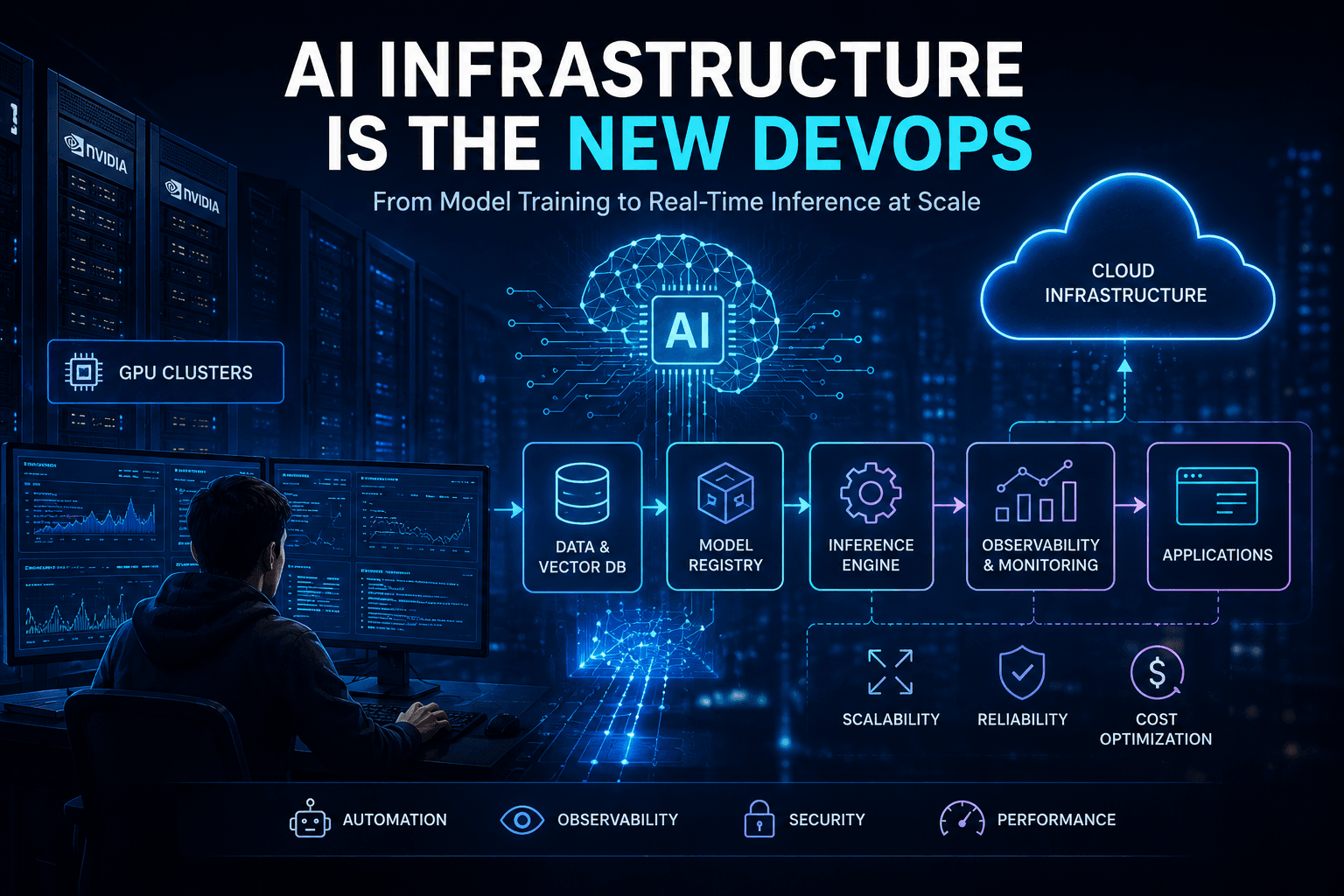
AI infrastructure has now moved into the center of enterprise engineering as companies expand large language model deployments and automated AI systems. Cloud providers, chip manufacturers, and software firms now invest heavily in GPU clusters, inference systems, and AI orchestration tools. The shift has changed how engineering teams manage applications in production environments.
Industry data from IDC showed that global AI infrastructure spending rose sharply in 2025 as enterprises increased investments in accelerated computing and model-serving platforms. Today, businesses care more about running AI workloads in large numbers compared to simply training AI models. This change has now led to the creation of novel engineering pipelines based on AI reliability and observability.
Enterprises Expand AI Infrastructure Operations
Old DevOps principles revolved around deterministic systems. Teams would track availability, deployment cycles, server health, and latency. With AI systems, however, there are different dynamics since outputs differ based on prompts, data sources, and models.

There is now a shift toward managing vector databases, model registries, inference engines, GPU schedulers, and retrieval systems in production environments. In addition, there is a need to track tokens, analyze response generation, and optimize memory usage for deployments.
Google Cloud highlighted this shift at its latest infrastructure updates regarding enterprise AI adoption. Google emphasized that there is a need to have a new level of orchestration for running inference-based workloads rather than conventional cloud applications.
AI observability has also emerged as an emerging sub-field of software operations in enterprises. Enterprises have begun tracking parameters like hallucinations, token consumption, throughput, and output consistency on their production models. These metrics are distinct from traditional application management tools in DevOps pipelines.
GPU Demand Changes Infrastructure Strategy
The significance of GPU-based infrastructure for enterprises in competitive scenarios is increasing as companies increase their scale in artificial intelligence solutions. Companies such as Nvidia, AMD, and the cloud providers keep investing in more data center capacity.
Reuters reported that Nvidia plans to expand its AI infrastructure partnerships through large-scale data center investments tied to GPU deployment and compute services. This growth is fueled by the increasing demand for AI inference capabilities by companies that develop generative AI solutions and automate their processes using AI models.
Moreover, companies incur higher infrastructure costs associated with model inference. AI processing consumes vast amounts of computing resources, network bandwidth, and memory space. Therefore, many companies today design efficient inference pipelines in order to minimize latency and cost.

Infrastructure engineers today spend more time on managing load balancing, route optimization, GPU management, and token optimization. All these responsibilities have become essential parts of AI operations roles within cloud infrastructure companies and enterprise software vendors.
AI Engineering Roles Continue to Evolve
AI infrastructure adoption has also led to a shift in recruitment patterns within the technology industry. Tech companies have started hiring engineers specializing in AI runtime infrastructure, MLOps tools, distributed inference, and AI observability solutions.

According to research papers published in 2026, AI runtime infrastructure was referred to as an independent execution platform for the surveillance and administration of intelligent models while in operation. The platforms were designed to ensure adaptive resource utilization, workload recovery, and enforcement of policies within AI systems.
Analysts predict that investment in enterprise AI will keep increasing as businesses adopt generative AI models in software engineering, search engines, customer services, and internal processes. Many enterprises now consider AI infrastructure as a sustainable operational platform and not just a technological fad.
Final Thoughts
As companies implement bigger AI systems, the management of infrastructure also evolves further from DevOps methodology. Modern-day engineers create systems optimized for inference reliability, scalability of models, and GPU computing loads.